

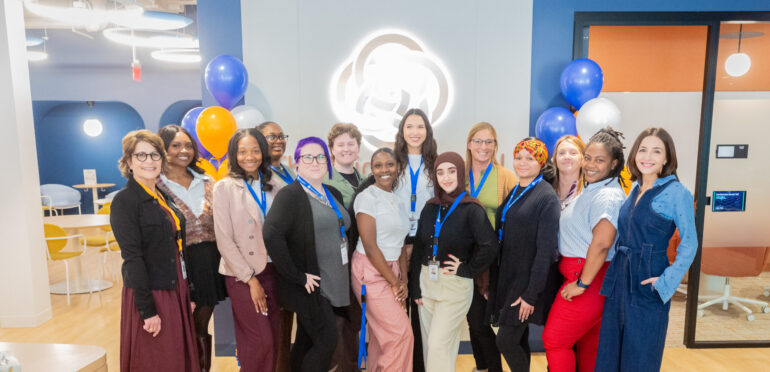
When Caitlyn Thomas, a first-year student in the Clinical Mental Health Counseling (CMHC) Online program at The Chicago School, flew from her home in Ohio to Washington, D.C., for a three-day residency, she didn’t know what to expect. Thomas first became interested in psychology at 7 years old when she entered counseling following a family trauma. At that age, she didn’t understand why she’d been placed there, but, she says, “I just knew I felt safe.”
Upon graduating from college, she enrolled in The Chicago School’s CMHC program. As a first-year student, she had been navigating the coursework and online instruction without difficulty but spending three days together with her instructor and classmates felt like a different level of challenge.
“I went to Washington, D.C., and into this big, beautiful new school,” Thomas recalls. “I didn’t know anybody, and I wasn’t sure if I was going to fit in.” However, as soon as she entered the room with Tracy Hunt, Ph.D., the instructor of the Helping Relationships & Skill Development course, Thomas says, “I felt back to being 7 years old, feeling safe and like this is what I want to do.”
Students Arrive With Anticipation and Some Nerves
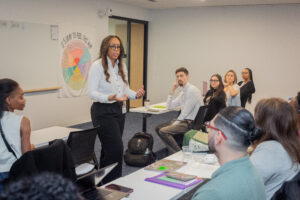 The CMHC Online program at The Chicago School allows working adults the flexibility to train to become clinically competent, ethical, and culturally informed mental health professionals from where they live. Their online education is augmented by two three-day residencies, one in each of the first two years of the program.
Cory Clark, Ph.D., a professor in the CMHC online program, explains how the two residencies work to augment the rigorous online coursework with in-person group exercises and skills evaluation: “The foundational courses the students take in their first year lead up to the first residency where they focus on micro skills of counseling: Can you reflect feeling? Can you reflect meaning? Can you build a rapport with someone who you just met?”
Each Year’s Residency Tests Newly Acquired Skills
After completing classes in treatment planning, assessment, and diagnosis, students attend another residency during their second year, which is part of a group counseling class. There, the attendees must demonstrate that they can lead a group session, integrate advanced skills in individual counseling sessions, and authentically participate in a group.
This part of the residency can be deeply emotional for the participants. “It’s a training group where students are asked to be real, authentic, vulnerable, and look at all the things that come up for them when they sit in a group with their peers and explore current topics in the field and all the things as future counselors together,” Dr. Clark says.
Participants Come Together in Shared Activities
At the end of each residency, the course instructor evaluates the participants according to a rubric with criteria such as nonverbal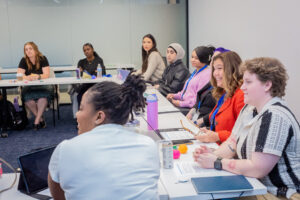 communication, session-closing summarization, and cultural competence.
While assessment of their performance in the moment was potentially anxiety-inducing, Thomas says her group viewed them as the culmination of three long, transformative days, and that as each participant returned to the room after meeting with Dr. Hunt, they received an ovation from their peers.
Thomas says this portion of the residency was the high point of her experience and found the very positive feedback she received particularly gratifying coming from Dr. Hunt, who she credits with making the three days a success for the participants. “She is an incredible professor and full of knowledge,” Thomas says.
Preparing for a Career of Service
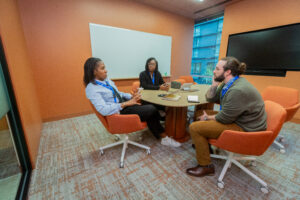 Colleen Malone, manager of the Counselor Education department, explains that the residencies both prepare students for practice and help to boost retention by bringing them together to share experiences. The CMHC course work and residencies integrate the practitioner model, which has been a hallmark of The Chicago School since its inception, training students to practice counseling skills; while the doctoral students in the Counselor Education and Supervision Ph.D. program practice their teaching skills as part of their preparation to become future counselor educators.
Additionally, Malone explains that the residencies provide an opportunity for “students to come together where everything becomes really tangible, really solidified, because they get to see their instructors in person, they get to see their cohort of students in person, and those bonds are formed, and it’s a very intense but emotionally safe weekend.”
For Thomas, the three-day residency not only solidified her sense of belonging within the program and the field more broadly but also clarified the next steps of her educational journey. “I would like to go into the Counselor Education and Supervision doctoral program,” she says, citing Dr. Hunt as the reason for that decision. “Watching her teach and just show all the skills that she has as a person has made me want to help other baby counselors and maybe even teach at The Chicago School one day in the same course.”